
The “Hidden Hazard” Fall: How I Prove Negligence in NYC Slip and Fall Cases
Michele Mirman | Slip & Fall Injuries | April 14, 2026
What Is a Hidden Hazard Slip and Fall in NYC?
A hidden hazard slip and fall in NYC occurs when a dangerous condition—such as a spill, debris, or wet surface—exists long enough that a property owner should have discovered and corrected it but failed to do so.
A hidden hazard slip and fall in NYC refers to a condition that is not immediately obvious but still creates a serious risk of injury under New York premises liability law.
When someone slips and falls in New York City, I often hear the same explanation from property owners. They claim they did not know the hazard was there or that they did not have time to fix it. In many cases, they argue that the dangerous condition appeared only moments before the accident. However, that explanation does not automatically eliminate liability.
In fact, proving negligence in slip and fall cases in NYC often comes down to uncovering what the property owner should have known—and when.
With over 40 years of experience handling New York slip and fall cases, I have seen how frequently this defense is used. I regularly investigate incidents in Manhattan retail stores, Brooklyn sidewalks, and high-traffic NYC building lobbies where hazards develop quickly, many times created by the property owner, but remain unaddressed.
What Is Considered a Hidden Hazard in New York City?
A hidden hazard is a dangerous condition that may not be immediately visible but still creates a foreseeable risk of harm. In a fast-moving environment like New York City, these hazards often form in areas with constant pedestrian activity.
For example, I frequently see cases involving:
- Spilled liquids in grocery stores and restaurants
- Debris left in walkways or entry areas
- Loose or curled floor mats in commercial buildings
- Leaking pipes from buildings that create hazards on the sidewalk
Because of the high volume of foot traffic in New York City, in our business areas and office buildings, these conditions can easily cause accidents and injuries.
Under NYC sidewalk liability, law property owners in New York are expected to conduct regular inspections, especially in high-traffic pedestrian zones. When they fail to do so, even a temporary hazard can lead to liability.
Even a small spill can cause a sudden loss of balance, leading to a serious fall. Many of my clients suffer fractures, head injuries, or spinal damage without any warning that a hazard was present.
How I Prove Negligence Under New York Premises Liability Law
Property owners often argue that the hazard “just happened.” However, under New York premises liability law, that defense is not enough. If the property owner can anticipate that a defective condition will exist or fails to regularly inspect or properly inspect, that owner can be responsible.
What if an owner’s building has a leaky pipe leading right out onto the sidewalk, making the sidewalk slippery, and the property owner simply ignores it?
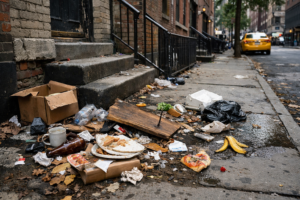
What if a property owner fails to install sufficient garbage cans, and the garbage routinely overflows onto the sidewalk?
What if a grocer waters his outdoor vegetable stands in the winter, creating ice on the sidewalk?
These are all instances where the owner should have anticipated the problem and corrected it.
To establish liability, I must prove that the property owner either created the dangerous condition or had actual notice or constructive notice of the dangerous condition.
Created the condition is just what it sounds like: the owner or the people who work for the owner actually took part in creating the dangerous condition.
Actual notice means the owner knew about the hazard. This can occur when an employee observes a spill with their own eyes or when a customer reports it to the employees themselves.
Constructive notice means the condition existed long enough that a reasonable inspection would have discovered it.
The law requires that property owners exercise reasonable care to monitor conditions on their premises, and reasonable care includes inspecting their premises.
Evidence I Use to Prove Negligence in NYC Premises Liability Cases
To build a strong case, I rely on multiple forms of evidence:
- Surveillance footage that shows how long the hazard existed
- Inspection and cleaning logs that reveal gaps in maintenance
- Witness testimony confirming the condition was present earlier
- Prior complaints or violations showing a pattern of neglect
- Expert testimony
- Photographs
- Prior accidents and lawsuits
In many cases, evidence shows that the condition existed longer than the property owner claims. As a result, what is described as a “sudden” hazard often turns out to be a preventable one.
Why Slip and Fall Claims Are Denied—and How I Challenge That
Insurance companies frequently deny slip and fall claims early in the process. They often argue that the hazard appeared moments before the fall, that the property owner had no notice, or that the injured person was distracted.
However, these defenses do not always reflect the full picture.
I approach every case with a structured and aggressive strategy. First, I establish a detailed timeline of events. Then, I analyze whether the property owner followed reasonable prevention, inspection and maintenance procedures.
Next, I request critical evidence, including surveillance footage and maintenance records. In many cases, I uncover inconsistencies such as missing inspection logs, delayed cleanup responses, or proof that the hazard existed longer than claimed.
As a result, I can often demonstrate that the property owner failed to meet their duty of care.
In short, property owners cannot avoid liability simply by claiming the hazard appeared suddenly.
What You Should Do After a Slip and Fall Accident in NYC
If you were injured in a slip and fall accident, your actions immediately after the incident can significantly impact your case.
You should:
- Take clear photographs of the hazard and surrounding area
- Report the incident to management
- Seek medical attention right away
- Preserve evidence, including clothing and footwear
- Get the names and contact information of witnesses
You should also speak with an attorney as soon as possible.
Learn more about your rights in a NYC slip and fall injury case:
Timing is critical. In New York City, hazards are often cleaned or repaired quickly due to constant public use. Surveillance footage may also be overwritten within days.
This matters because once evidence disappears, proving negligence becomes more difficult.
Get a free, no obligation case review
get a free case reviewCommon Questions About Hidden Hazard Slip and Fall Cases in NYC
Can I file a claim if the hazard just happened?
Yes. You may still have a case if the property owner failed to conduct reasonable inspections or should have discovered the condition.
What is constructive notice in New York?
Constructive notice means the hazard existed long enough that a reasonable property owner should have identified and corrected it.
Are property owners responsible for temporary hazards?
Yes. Property owners must take reasonable steps to inspect and address hazards, even if they are temporary.
Speak With an Experienced NYC Slip and Fall Attorney
If you were injured in a slip and fall accident, do not assume you do not have a case. Even when a property owner claims the hazard “just happened,” there may still be strong evidence of negligence.
For more than 40 years, I have helped injured New Yorkers hold negligent property owners accountable. I understand how to investigate these claims, uncover critical evidence, and build a case that supports my clients’ rights.
At Mirman, Markovits & Landau, P.C., I will review your situation carefully and explain your legal options.
Call today for a free consultation. Let me help you pursue the compensation you deserve. Reach us at 212-227-4000