
Cracked Sidewalks in NYC: Who Is Liable?
Michele Mirman | Slip & Fall Injuries | April 8, 2026
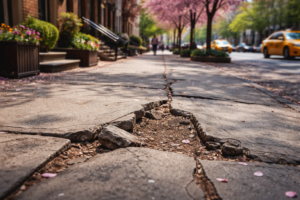
Every spring in New York City, when we all start spending more time outside, I speak with people who were simply walking down the sidewalk when their lives changed. A raised slab of concrete, a hidden crack, or a broken sidewalk panel caused them to trip and fall.
Cracked sidewalks in NYC are one of the most common causes of trip and fall accidents, yet many victims do not know who is responsible or whether they have a legal case.
Who Is Responsible for Cracked Sidewalks in NYC?
This is one of the first questions my clients ask. The answer surprises many people.
In most cases, New York City law places responsibility on property owners—not the City—for sidewalk maintenance. Therefore, cracked sidewalks in NYC are the property owners’ responsibility.
According to NYC Administrative Code §7-210:
- Property owners must maintain sidewalks in a reasonably safe condition
- They are responsible for repairing cracks, breaks, and defects
- They may be liable if someone is injured due to negligence
However, there are exceptions when the city of New York may be liable.
The City may be responsible if:
- The property is City-owned
- The defect was caused by municipal work
- The sidewalk is adjacent to certain public buildings
- The defect is in front of a 1, 2 or 3 family, owner-occupied home with no commercial tenants.
- The City had prior written actual notice of the defect at least 15 days before the accident.
In addition, cases against the City require strict procedures. For example, you must file a Notice of Claim within 90 days, submit to a hearing conducted by New York City, and start your lawsuit within one year and 90 days from your accident.
Legal cases have also arisen through the years which hold that minor or trivial defects may not meet the legal threshold for a dangerous condition. However, when a crack becomes large, uneven, or hazardous enough to pose a clear risk to pedestrians, it may give rise to a valid claim.
How I Prove Liability in Cracked Sidewalk Cases Against Property Owners
Property owners often argue that they were unaware of the defect. However, that defense does not always hold up under closer examination. In order to establish liability, I must demonstrate that the sidewalk condition was dangerous, that the property owner either knew or should have known about it, and that they failed to repair it within a reasonable amount of time.
To support these claims, I rely on several forms of evidence that help build a clear and compelling case. Photographs of the sidewalk defect are critical, especially when they show the size, depth, or visibility of the hazard. In addition, witness statements can provide valuable insight into how long the condition existed or whether others noticed it before the incident. Prior complaints, other lawsuits, or recorded violations may further establish the defect and the failure of the owner to maintain the sidewalk. Maintenance records can reveal whether the property owner conducted regular inspections or ignored necessary repairs. In some cases, I also work with experts who can evaluate the condition and determine how long the defect was present.
Taken together, this evidence can demonstrate what the law refers to as “constructive notice,” which means that, under the circumstances, the condition existed for so long that the owner should have seen it and repaired it. In many cases, when a crack or uneven surface has been visible for weeks or even months, it supports the conclusion that the property owner should have discovered and addressed the hazard before someone was injured.
Constructive notice does not apply to New York City. The only way to prove that New York City is responsible for a defective sidewalk is to prove that the City either created the condition or received written notice of the defect at least fifteen days before an accident.
Common Injuries from Sidewalk Trip and Fall Accidents
Unfortunately, trip and fall accidents result, according to the CDC, in some of the most serious injuries, including disabling injuries and death, worldwide.
I regularly represent clients who suffer:
- Broken wrists and arms,
- Hip fractures
- Knee injuries
- Head trauma, concussions, traumatic brain injuries
- Back and spinal injuries
Moreover, these injuries many times require surgery and lead to long-term medical treatment and lost income.
What You Should Do After a Sidewalk Fall in NYC
If you trip on a cracked sidewalk, your actions matter.
Take These Steps Immediately
- Take photos of the exact location
- Capture the defect from multiple angles
- Get witness contact information
- Seek medical attention right away
- Report the incident if possible
Then, speak with an experienced slip and fall attorney.
Many people assume that sidewalk accident cases are straightforward. However, that is rarely the case. In reality, these claims often involve complexities that can significantly impact the outcome. For example, liability may shift between multiple parties, especially when questions arise about property ownership, maintenance responsibilities, or recent construction work. In addition, the defect that caused the accident is often repaired quickly after the incident, making it difficult to document the dangerous condition as it existed at the time of the fall. Insurance companies frequently deny responsibility at the outset, relying on limited information or disputing key elements of the claim.
As a result, investigation is critical. Acting quickly allows important evidence to be preserved, responsibilities to be properly identified, and a stronger case to be built from the very beginning.
Get a free, no obligation case review
get a free case reviewHow I Help Clients Injured by Cracked Sidewalks
For over 40 years, I have helped injured New Yorkers hold New York City and negligent property owners accountable.
I approach every case with a clear and methodical strategy designed to uncover the truth and build the strongest possible claim. First, I conduct a thorough investigation into the circumstances surrounding the accident, carefully examining how and why it occurred. At the same time, I work to preserve critical evidence, ensuring that important details—such as photographs, witness accounts, and site conditions—are not lost or altered. When necessary, I consult with qualified experts who can provide insight into the nature of the hazard and help establish how long it existed. In addition, I aggressively negotiate with insurance companies, advocating for my clients and pushing back against efforts to minimize or deny valid claims.
Most importantly, I focus on getting my clients the compensation they deserve. If you were injured due to a cracked or broken sidewalk in NYC, you do not have to handle this alone. At Mirman, Markovits & Landau, P.C., I will evaluate your case, explain your options, and work to get you the compensation you deserve.
Call today at 212-227-4000 for a free consultation. Let me help you move forward.