
Big Trucks, Blind Spots, and a Heartbreaking East Village Crash: An NYC Truck Accident Lawyer Explains
Michele Mirman | Truck Accidents | September 21, 2026
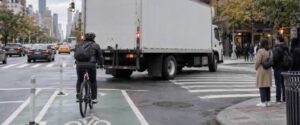
A terrible crash in the East Village has left one family grieving and another teenager recovering. On Friday night, a commercial truck driver making a right turn from westbound East 14th Street onto First Avenue struck two girls riding the same electric Citi Bike.
Fifteen-year-old Daria Serkov was taken to Bellevue Hospital, where she was pronounced dead. The other girl, the 16-year-old driver of the e-bike, was last reported to be in stable condition. Our hearts go out to Daria’s family, friends, classmates, and everyone who loved her. We are also wishing the injured teenager strength and a full recovery. Police are still investigating the crash.
This is the kind of news that stops you cold. These two young New Yorkers should have made it home. It is also a painful reminder of why an NYC truck accident lawyer must carefully examine a commercial vehicle’s blind spots, movements, safety equipment, and the driver’s actions after a devastating collision.
It also shines a painful light on a danger we New Yorkers face every day: trucks and buses are not just bigger cars. They are taller, heavier, slower to stop, and much harder to see around. Put one into a crowded intersection with pedestrians, bicycles, delivery riders, strollers, and impatient traffic, and there is no room for error.
Why Truck Blind Spots Put New Yorkers at Risk
Blind spots are a major problem. A truck or bus driver may be unable to see areas directly in front of the cab, beside the vehicle, or behind it. Children are particularly difficult to spot because they are smaller. Here’s the frightening part: you may be able to see the vehicle perfectly while its driver has no idea you’re there.
Truck blind spot accidents often happen when a cyclist or pedestrian enters an area that the driver cannot see through the vehicle’s windows or mirrors. That does not excuse an unsafe turn. Commercial drivers must account for their vehicles’ visibility limitations and take every reasonable precaution before moving through an intersection.
Right Turns Create a Dangerous Squeeze Point
Turning makes everything more dangerous. When a long truck or bus rounds a corner, its rear wheels follow a tighter path than its front wheels. That creates a squeeze point beside the curb, right where a cyclist or pedestrian may be traveling. The back of the vehicle can also swing across a bike lane or crosswalk. Add a blocked sightline, a rushed turn, or a driver trying to beat the light, and things can go terribly wrong in seconds.
Large vehicles also need more time and distance to stop, especially when loaded or traveling on wet pavement. And because pedestrians and cyclists have no steel frame, airbags, or seat belts protecting them, even a low-speed impact can cause catastrophic injuries. Someone who is knocked down may also be pulled beneath the vehicle’s wheels.
A commercial vehicle accident attorney may also examine whether the truck had appropriate mirrors, cameras, warning systems, side guards, and other safety equipment. When companies place large vehicles on crowded city streets, they should take every reasonable step to protect the public
So what can New York City do?
New York City can do plenty.
For starters, safer equipment on trucks and buses should be standard: lower, high-visibility cabs; crossover mirrors; cameras; blind-spot alerts; automatic emergency braking; audible turn warnings; and side guards designed to keep people from falling beneath a truck. The city can lead with changes to its own fleet and use contracts, permits, and purchasing rules to push private operators toward the same protections.
Street design needs to do safety work too. Protected intersections, bike-specific signals, pedestrian head starts, curb extensions, daylighted corners, and physical barriers that keep vehicles out of bike lanes can help everyone see one another sooner. Trucks also need properly placed loading zones so drivers aren’t double-parking or forcing cyclists into traffic.
These measures should remain central to the broader conversation about New York City bicycle safety.
And yes, the rules need teeth. Enforce safe speeds, truck routes, parking restrictions, and the duty to yield. Train commercial drivers to check blind spots repeatedly and make slow, careful turns. Give them realistic schedules that don’t reward rushing through crowded neighborhoods.
An NYC truck accident lawyer can investigate whether a driver violated traffic laws, ignored required safety procedures, lacked proper training, or operated under employer pressure. Depending on the evidence, a trucking company, vehicle owner, contractor, or another party may share responsibility for the harm caused.
One Careful Decision Can Save a Life
If you’re driving any vehicle, approach every corner expecting someone to be there. Signal early. Slow down. Check again. If a cyclist is alongside you, wait.
If you’re walking or biking, avoid lingering beside a large vehicle near an intersection and never try to pass one that has started turning. Stay visible—but remember, the legal and moral responsibility to make a safe turn rests with the driver.
New Yorkers share tight, busy streets. We can’t bring Daria back, but we can honor her by refusing to accept preventable deaths as the price of getting around. Safer vehicles, smarter streets, serious enforcement, and one extra moment of patience can help make sure more families welcome their children home.
If a truck driver’s unsafe actions have injured you or taken someone you love, an experienced NYC truck accident lawyer can investigate what happened, preserve critical evidence, and help your family understand its legal options.
I’m Michele Mirman. My law firm and I have been representing injured New Yorkers and their families in the New York Courts for over forty years. Call me. I can help. 212-227-4000