
A Fall Should Never Be “Part of the Job”: Construction Fall Accidents and the Safety Measures That Save Lives
Michele Mirman | Construction Accidents,Slip & Fall Injuries,Trip & Fall Injuries | August 21, 2026
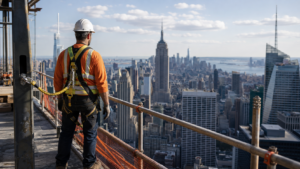
Every construction worker leaves someone waiting at home. A spouse expects a familiar key in the door. A child expects help with homework. A parent expects a call after the shift. Construction fall accidents are among the most devastating incidents families can face. When a worker falls from a roof, scaffold, ladder, or unfinished floor, the harm does not stop at the jobsite gate. It reaches an entire family.
That is why it is not enough to dismiss falls as an unavoidable danger of building New York. They are the construction industry’s leading cause of death—and they are preventable.
Construction fall accidents remain a leading cause of workplace fatalities. The latest figures from OSHA report fatal falls from a height as 389 of 1,034 construction fatalities in 2024. That is, roughly one-third of all construction deaths. And the problem is clear and apparent: the failure of job sites to ensure proper and adequate fall protection is the most frequently violated workplace-safety standard with scaffolding, ladder, and fall-protection training also appearing in the top ten.
Behind each number is a person whose life should have mattered more than a deadline.
New York City Has Seen the Cost Up Close
New York’s skyline is a monument to skilled labor, but its construction history carries painful reminders of how we suffer when protections fail.
In June 2019, a worker died after falling from an unpermitted scaffold at 880 St. Nicholas Avenue in Manhattan. The New York City Department of Buildings said the scaffold lacked critical safeguards, including proper guardrails and adequate planking, and that workers lacked required scaffold-safety training.
On June 5, 2024, at 38-29 30th Street in Queens, a worker attempting to climb down a 30-foot scaffold fell approximately 18 feet and later died. The scaffold did not match its approved drawings and was missing planks, guardrails, toe boards, and end rails.
Just weeks later, at 1505 Park Avenue in East Harlem, a ground-level worker became entangled in hoisting rigging, was pulled toward the roof of an 18-story building, and fell. DOB reported that the crew was using the equipment without appropriate training or required qualified supervision and that adequate pre-shift safety-meeting and site-orientation records were absent.
The lessons are painfully familiar: planning, supervision, and training are life-safety measures, not paperwork.
Plan, Provide, Train: Three Words That Can Bring a Worker Home
Preventing construction fall accidents requires employers to address hazards before a worker ever leaves the ground. OSHA’s nationwide Stop Falls campaign reduces prevention to three memorable duties: Plan. Provide. Train. Simple words, but they require real commitment.
Plan the work before anyone leaves the ground
A safe job begins before the first ladder is opened. The employer should decide how each task will be performed, identify roof edges, floor holes, skylights, unstable surfaces, scaffold access points, and other fall hazards, and select protection suited to those hazards.
Safety must also be part of the price of the job. Estimates should include proper scaffolding, aerial or scissor lifts, guardrails, anchors, harnesses, and rescue resources. If these costs are treated as optional extras, workers may be asked to improvise when schedules tighten. No bid is truly complete if it does not include the cost of sending everyone home safely.
Provide the right protection for the actual task
Under OSHA’s general construction rule, workers exposed to falls of six feet or more above a lower level require fall protection, although task-specific rules can differ. Employers must provide the correct equipment without charging workers and must make sure it fits, is compatible, and is appropriate for the work.
Protection should address the entire route: safe access, the work position, movement between locations, and prompt rescue after a fall.
Train every worker in a language and manner they understand
Workers need hands-on instruction in recognizing hazards and in setting up, inspecting, connecting, and using their equipment. Training should cover what changes when the job changes. It should also create room for a worker to say, “This does not look safe,” without fear of retaliation.
A hurried toolbox talk or a signature on a form is not enough if a worker still does not know where to tie off.
The Systems That Stand Between a Worker and a Fall
The best approach is often to prevent the fall in the first place, then back up that protection with systems that limit harm.
- Guardrails place a physical barrier along open floors, roof edges, ramps, and other exposed sides. Because they protect everyone in the area without requiring each person to connect a device, they are a strong first-line control.
- Personal fall arrest systems (PFAS) generally combine a properly fitted full-body harness, a connector such as a shock-absorbing lanyard or self-retracting lifeline, and a secure anchor. The parts must be compatible, and the system must provide enough clearance to arrest the fall before the worker hits a lower level.
- Safety nets, properly installed beneath elevated work, can catch a falling worker and reduce the distance and force of a fall. They must be positioned, tested, and maintained in accordance with applicable requirements.
- Safer ladder alternatives can remove avoidable exposure. Depending on the task, an aerial lift, scissor platform, or properly erected rolling scaffold may provide a stable work surface. The alternative itself must still be selected, inspected, and used correctly.
Inspection, Maintenance, and Rescue Cannot Be Afterthoughts
OSHA requires fall-protection systems to be inspected before use and defective components to be removed from service. Scaffolds must be inspected by a competent person before each shift and after events that could affect their integrity. Employers must also follow the manufacturer’s instructions and maintain documented periodic inspections.
There must also be a rescue plan. A worker left suspended in a harness can face a medical emergency. Calling 911 may be part of the response, but it should not be the entire plan. The crew should know who initiates rescue, what equipment is available, and how rescuers will reach the worker without creating another victim.
Accountability Is Part of Prevention
When a serious fall occurs, the first questions should be humane ones: Is the worker receiving care? Has the family been notified and supported? Then comes the investigation—not to reflexively blame the person who fell, but to understand the full system: Was the edge guarded? Was a suitable anchor available? Did the worker receive meaningful training? Was the scaffold complete? Did production pressure overrule safety? The same questions apply to falls away from a job site, in a store aisle or on an icy walkway. Brad Kendall, a slip and fall lawyer in Kansas City, says, “A fall case comes down to what the owner knew and what they did about it. We look for the inspection records, the earlier complaints and the camera footage before any of it disappears.”
In New York, workers injured in construction fall accidents may have rights beyond workers’ compensation. Depending on the facts, New York Labor Law protects workers when it comes to scaffolds, ladders, and elevation-related hazards. Every case is different, and strict deadlines affect claims, so workers and families should consider speaking promptly with an attorney experienced in construction accidents. This article is general information, not legal advice.
Get a free, no obligation case review
get a free case reviewThe deeper truth is not legal or technical. Construction workers are not replaceable parts. They are neighbors, parents, partners, and friends. Planning, equipment, training, inspection, and accountability are how an industry proves it understands that truth.
Were you or a family member hurt on a construction job? Call us at Mirman, Markovits & Landau, PC at 211-227-4000. We’re here for you. We’ve been representing New York City construction workers in the New York Courts for over 40 years.